


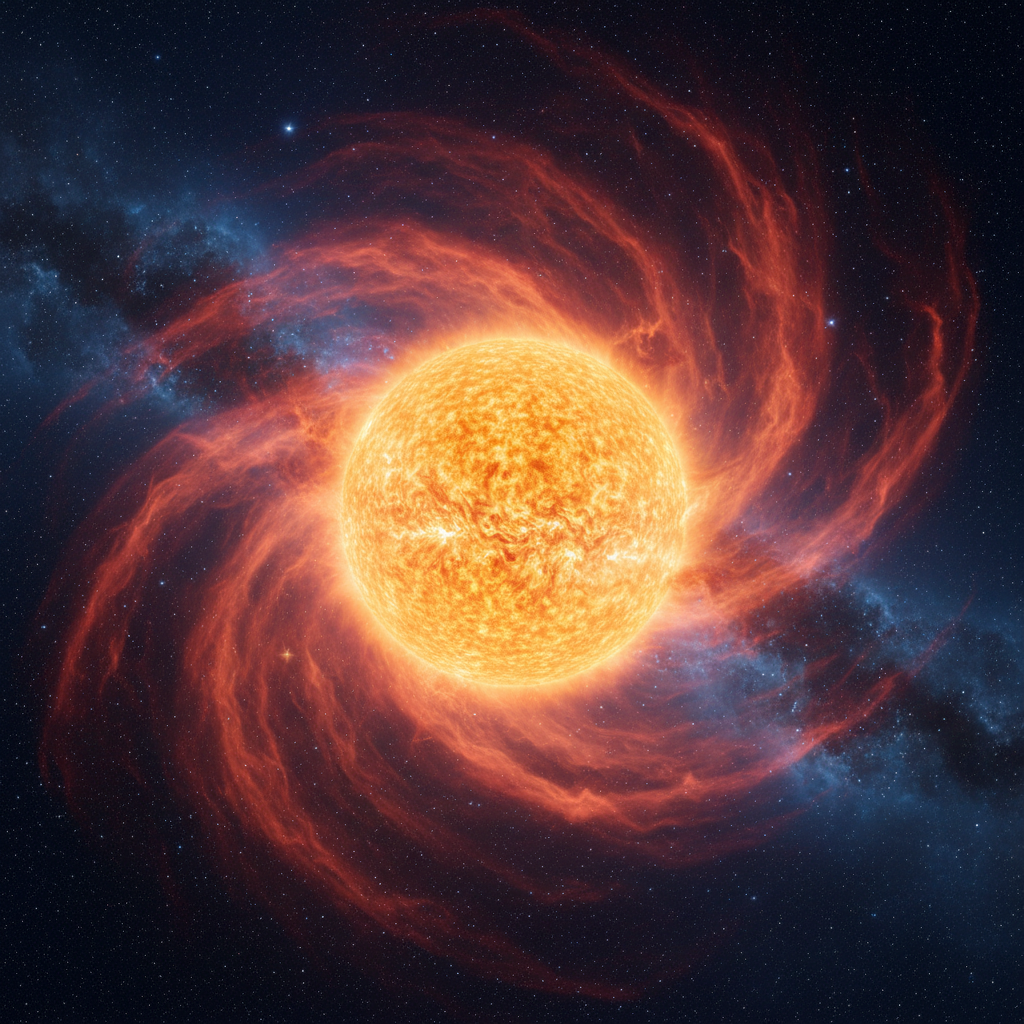
Astronomers are baffled and excited as one of the universe’s most massive stars undergoes a dramatic, rapid change right before their eyes.
What’s the story?
Imagine looking up at the night sky and thinking everything is constant, right? Well, astronomers just got a huge reminder that the cosmos can be incredibly dynamic, even on a human timescale! They’re currently watching a truly enormous star, named WOH G64, in a nearby galaxy called the Large Magellanic Cloud, do something totally unexpected.
For decades, WOH G64 was known as a classic red supergiant, one of the biggest and brightest stars out there. But around 2011, it started to dim, and when it brightened again a couple of years later, it looked completely different! Its surface temperature jumped by a whopping 1,800 degrees Fahrenheit, and its color shifted from deep red to a much hotter yellow. It was such a dramatic change that scientists initially thought they were looking at a different star altogether.
Why does it matter?
This isn’t just a cool cosmic light show; it’s a front-row seat to stellar evolution, which is usually a process that unfolds over millions of years. Watching a star change so rapidly gives scientists a rare, real-time opportunity to understand how these colossal stars live, evolve, and eventually die. It’s like getting to see a butterfly emerge from its chrysalis in fast-forward, giving us clues about its entire life cycle.
Understanding these massive stars is crucial because they play a huge role in shaping galaxies. They produce and distribute heavy elements necessary for planets and life, and their explosive deaths (supernovae) can trigger new star formation. Plus, this event highlights the incredible power and unpredictability of the universe, reminding us that even our best theories can be challenged by new observations.
The deeper context
WOH G64 is truly a giant, estimated to be about 1,540 times the size of our Sun. Stars this massive burn through their fuel incredibly quickly and shed a lot of material as they age, often surrounded by thick cocoons of gas and dust. For years, astronomers tracked WOH G64, even noticing a regular pulsation in its brightness, almost like a cosmic heartbeat.
But then came the big shift. Scientists have two main theories for what caused this dramatic transformation, and both are pretty wild. The first idea is that WOH G64 isn’t alone; it might be part of a binary system, meaning it has a companion star. An interaction between these two stars could have caused WOH G64 to suddenly eject its outer atmosphere, revealing hotter, yellower layers underneath. It’s like shedding a thick, red coat to reveal a brighter, warmer core.
The second theory is almost the opposite: perhaps WOH G64 was always a warmer, yellower star, but for decades, it was shrouded in a long-lasting eruption of material that made it appear red. As this obscuring veil thinned out, its true, hotter color was revealed. Imagine a star hiding behind a dusty curtain that finally blows away. The scientific community is still debating which scenario is correct, and some even suggest that the star’s red supergiant signatures might have returned at times, adding to the mystery.
This whole saga is particularly important because it relates to what astronomers call the ‘red supergiant problem.’ We expect these massive red supergiants to end their lives in spectacular supernova explosions, but we rarely see them as direct precursors to supernovae. This observation of WOH G64 changing its appearance could mean that some stars transform into a different phase before their final, explosive act, making them harder to identify as supernova candidates. It’s a puzzle piece that could help us better predict when and where these cosmic fireworks will occur.
What you should know
First off, this isn’t a sign of immediate danger to Earth – WOH G64 is 160,000 light-years away, so any potential supernova won’t affect us. What’s important is that astronomers will be watching WOH G64 very closely. Continuous observations, using powerful telescopes and advanced techniques, will help them test these theories and see if the ‘yellow’ state persists, or if other changes occur. Keep an eye out for updates from observatories like the European Southern Observatory and NASA.
Secondly, this story is a fantastic reminder of the value of long-term scientific monitoring. It took decades of patient observation to even notice this dramatic change. It also subtly highlights the issue of light pollution. To truly appreciate and study these cosmic wonders, we need dark skies. So, next time you’re thinking about outdoor lighting, remember that shielded fixtures and turning off unnecessary lights not only save energy but also help preserve our view of the universe, which is a shared natural heritage for all of us.
Isn’t it incredible to think about the sheer scale and dynamic nature of the universe? Just when we think we have a handle on how things work, a star like WOH G64 comes along and throws us a cosmic curveball, reminding us there’s always more to learn and discover. It truly makes you wonder what other celestial surprises are waiting to be unveiled. So, let’s keep looking up, shall we, and stay curious about the ever-unfolding drama above our heads!
Originally sourced from: https://www.ecoticias.com/en/astronomers-are-holding-their-breath-one-of-the-most-massive-stars-in-the-universe-has-entered-a-strange-and-unstable-phase-and-no-one-knows-what-might-happen-next/30857/
