


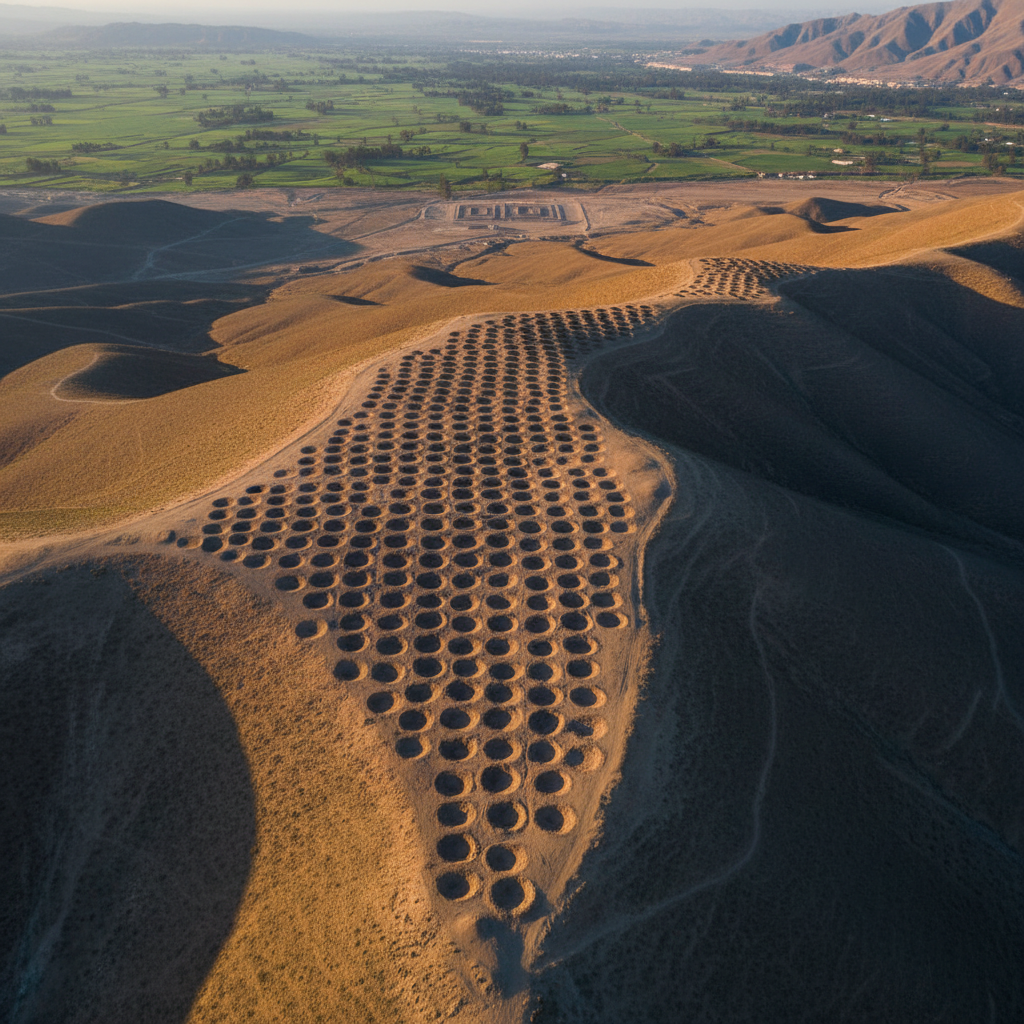
Archaeologists unveil Monte Sierpe, a monumental open-air accounting system that reveals the sophisticated economic secrets of the largest pre-Columbian empire.
What’s the story?
Imagine flying over the Pisco Valley in southern Peru, and seeing a massive, serrated spine carved into a barren mountain ridge. This isn’t a natural formation; it’s a meticulously crafted series of over 5,200 pits, each about a meter wide and deep, stretching for an astonishing 1.5 kilometers. For decades, this enigmatic site, known as Monte Sierpe or the ‘Band of Holes,’ has baffled archaeologists and local residents alike. Theories ranged from defensive positions to ancient burial grounds, or even markers for extraterrestrial visitors. It was a persistent, tantalizing puzzle in the heart of the Andes.
But now, thanks to groundbreaking research led by Charles Stanish of the University of South Florida and Henry Tantaleán of the Universidad Nacional Mayor de San Marcos, the mystery has been cracked. Their detailed study, involving drone mapping, soil analysis, and carbon dating, has revealed a far more ingenious and historically grounded purpose. Monte Sierpe was not a ceremonial site or a fortress; it was a colossal, public accounting tool, a permanent ledger carved into the landscape by the mighty Inca Empire.
This discovery fundamentally reshapes our understanding of Inca administrative prowess. In an empire that spanned thousands of kilometers without a monetary currency or a widespread written language, managing vast resources was a monumental challenge. The Band of Holes now stands as a testament to the Inca’s innovative solutions, providing a visible, transparent mechanism for tracking the flow of tribute and labor across their diverse territories, making the invisible hand of imperial bureaucracy strikingly visible.
Why does it matter?
This isn’t just another archaeological find; it’s a profound re-evaluation of how one of the most powerful pre-Columbian civilizations managed its economy and governed its people. The Inca Empire, or Tawantinsuyu, was a marvel of organization, stretching over 4,000 kilometers along the Andes. Its administrative backbone was the ‘mit’a’ system, a sophisticated form of labor taxation where citizens contributed work, agricultural products, textiles, and other goods instead of currency. Understanding how they verified and managed this tribute is crucial to grasping the empire’s stability and growth.
For historians and archaeologists, Monte Sierpe provides a missing piece in the puzzle of Inca governance. While the quipu, a system of knotted strings, is well-known for recording numerical data, it was a portable record often managed by individual officials. Monte Sierpe suggests a complementary, large-scale, and publicly visible system that ensured accountability across vast distances and diverse populations. This dual approach highlights the Inca’s unparalleled ingenuity in statecraft, demonstrating how they maintained control and redistributed resources without the tools we typically associate with complex empires.
Beyond academia, this discovery matters because it challenges our preconceived notions about what constitutes ‘advanced’ civilization. The Inca achieved monumental feats of engineering, social organization, and economic management without a written script or currency. Monte Sierpe serves as a powerful reminder that human ingenuity takes many forms, and that sophisticated systems can emerge from different cultural and technological foundations. It enriches our appreciation for the complex societies that flourished in the Americas long before European contact, offering lessons in resource management and governance that resonate even today.
The deeper context
To truly appreciate Monte Sierpe, we need to step back into the vibrant, complex world of the Inca Empire. Flourishing from the early 15th century until the Spanish conquest in 1532, the Inca ruled the largest empire in pre-Columbian America. Their genius lay in their administrative structure, particularly the ‘mit’a’ system. This wasn’t just taxation; it was a reciprocal public service where citizens contributed labor, agricultural products like maize and potatoes, and textiles, which the state then redistributed, funded public works, and supported its elite and military. The challenge was immense: how do you track millions of items and labor quotas across diverse climates and terrains without a written language or money?
For decades, the quipu, a complex system of knotted strings, was considered the primary answer. These intricate devices recorded numerical and possibly narrative information, managed by specialists called *quipucamayocs*. However, quipus were portable and often localized. The central question remained: how did the Inca state create a transparent, public, and large-scale accounting system that could integrate regional contributions into the central bureaucracy and ensure accountability across such a vast domain? This is where Monte Sierpe steps in, offering a compelling answer to a long-standing mystery.
The archaeological evidence supporting the ‘accounting tool’ theory is robust and multi-faceted. Detailed drone mapping revealed that the 5,200 pits are not random but organized into distinct blocks, varying in pit count, correlating with Inca resource management methods. Crucially, the site’s strategic location is key: it sits directly above a major Inca storage complex (a *qollqa*) and is adjacent to the Camino Real (Royal Road), the empire’s primary artery for moving goods, troops, and officials. Anything traveling through the Pisco Valley would have passed within sight of these pits, making them ideal for public verification.
What most people don’t realize is the sheer ingenuity of using the landscape itself as a public ledger. The pits are located on a slope, easily visible from the valley floor, reinforcing their role as a transparent, macro-accounting system. This allowed different groups – tribute payers, regional administrators, central authorities – to visually confirm contributions. Unlike other pre-Inca earthworks like the Nazca Lines, which likely had ceremonial or astronomical functions, Monte Sierpe’s repetitive, block-like structure and strategic placement firmly point to an administrative purpose. The construction itself, a massive mit’a project using traditional tools like the *chakitaklla* (foot plow), further aligns with known Inca state engineering.
The theory is also strengthened by the *absence* of evidence for previously dismissed ideas. Excavations found no human remains or funerary offerings, refuting the burial ground theory. The pits lack strategic defensive placement or associated fortifications, ruling out military use. And despite the Inca’s astronomical prowess, no systematic alignments with celestial bodies have been found. This scientific process of elimination, combined with precise carbon dating placing the site squarely within the Inca occupation (roughly 1400-1532 CE), makes the ‘accounting tool’ theory exceptionally compelling.
The Pisco Valley itself has a rich pre-Inca history, home to cultures like the Paracas, Nazca, and most notably, the Chincha Kingdom. The Chincha, a powerful maritime trading state, were incorporated into the Inca Empire around the mid-15th century. These local populations would have been fully integrated into the mit’a system, contributing agricultural products, textiles (especially cotton, given their expertise), and labor for imperial projects. For them, Monte Sierpe would have been a constant, monumental reminder of their obligations and a public display of their collective fulfillment, reinforcing Inca authority and the flow of resources.
While the Spanish conquest in 1532 dramatically disrupted these systems, leading to the abandonment and eventual forgetting of Monte Sierpe’s purpose, its rediscovery underscores the profound impact of colonial disruption on indigenous knowledge. There are no known direct colonial records or indigenous accounts specifically describing Monte Sierpe, highlighting how the Spanish imposition of monetary economies and written records obscured the sophisticated non-monetary systems that once thrived. This makes the archaeological reconstruction of sites like Monte Sierpe even more vital for understanding the full scope of Inca genius.
What you should know
First, understand that Monte Sierpe represents a critical piece of the Inca’s sophisticated administrative puzzle. It wasn’t just about collecting tribute; it was about managing an empire without currency or widespread writing. Think of it as a monumental, public spreadsheet, complementing the more detailed, portable quipu records. This dual system allowed for both granular data management and transparent, macro-level oversight, a testament to their administrative flexibility.
Second, the strategic location of Monte Sierpe is paramount. Its position overlooking the fertile Pisco Valley, adjacent to the Camino Real and a major *qollqa* (storage facility), means it was at a vital crossroads of Inca logistics. This wasn’t a random placement; it was a carefully chosen site to monitor the flow of goods like maize, cotton textiles, and marine products, and to verify the labor contributions of local communities like the Chincha, who were integrated into the imperial system.
Finally, what’s genuinely surprising is how this discovery challenges our notions of ‘advanced’ accounting. We often associate complex record-keeping with written language and monetary systems. The Inca, however, developed a highly effective, non-literate, and non-monetary system that was both flexible and transparent. The 5,200 pits, each potentially representing a standard unit of tribute (e.g., a basket of maize or a bundle of textiles), demonstrate a level of organizational scale and public accountability that was far ahead of its time, proving that ingenuity can manifest in unexpected forms. Keep an eye on future research that might further decipher the specific units or the dynamic operational aspects of this grand ledger.
So, the next time you hear about ancient civilizations, remember Monte Sierpe. It’s a powerful reminder that history is full of hidden complexities and ingenious solutions, often waiting patiently for us to look a little closer, dig a little deeper, and reconsider our assumptions. The Inca, without paper or coin, carved their balance sheets into the very earth, leaving a legacy of administrative brilliance that continues to amaze and inform us today. Stay curious, my friends, for the world is still full of wonders waiting to be genuinely understood.
Originally sourced from: https://dailygalaxy.com/2026/03/peru-band-of-holes-5200-pits-mystery-solved/
